Security and safety window film
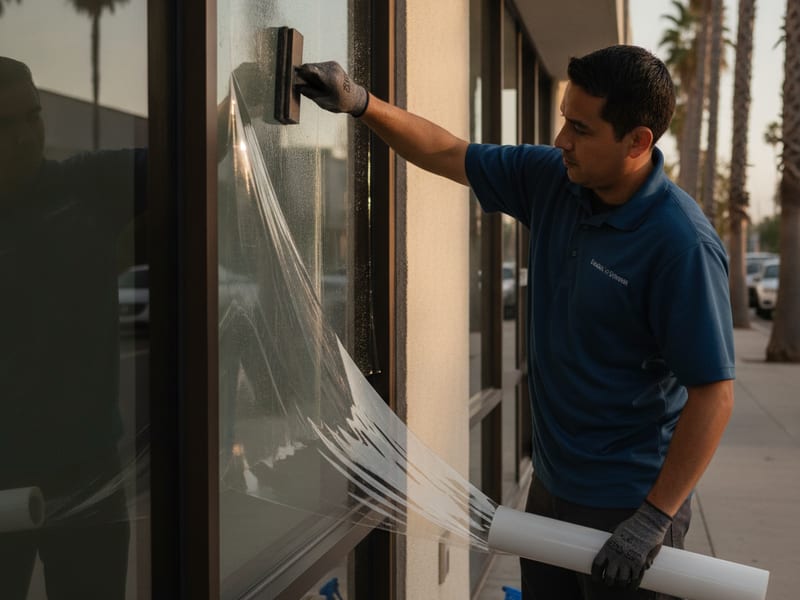
Security window film does not make glass shatterproof, but it does hold broken glass in place, slow forced entry, and reduce injury risk from accidental impacts. Understanding what it actually does helps you decide whether it fits your situation.
What you'll learn
- The difference between safety film (injury prevention) and security film (forced-entry delay)
- How film thickness in mils affects performance and what thickness fits which application
- Why anchoring the film to the frame changes impact resistance significantly
- Which San Diego property types benefit most from security film
Step by step
- Understand the two categories Safety film and security film are related but different. Safety film (typically 4-8 mil) holds glass fragments in place after breakage to prevent injury. It is the standard for schools, daycares, and any space where glass breakage from accidents is a risk. Security film (typically 8-14 mil or thicker) also holds glass together and adds resistance to repeated impacts, slowing forced entry. Most residential applications use safety film. Ground-floor commercial applications with theft risk often use security film.
- Learn the mil thickness scale Film thickness is measured in mils (thousandths of an inch). A standard window film is 1-2 mil. Safety film starts at 4 mil. Security film runs 8 mil and above. The thicker the film, the more energy required to push broken glass through it. At 12 mil or above, a film can hold fractured glass in place through multiple hammer impacts, which is the barrier that matters in a smash-and-grab scenario.
- Ask about mechanical anchoring Film anchored to the window frame with an anchoring system performs significantly better than film applied to the glass alone. Without anchoring, a hard impact can separate the film from the frame even if the glass holds together. Anchoring transfers impact force to the frame instead of just relying on the film adhesive. For security applications, ask installers specifically whether their quote includes a frame anchor system.
- Consider blast mitigation if your building warrants it Some security films carry blast-mitigation ratings from federal testing programs. These are primarily relevant for government buildings, financial institutions, or any property that has received a credible threat assessment. For standard residential and small commercial applications, blast-mitigation ratings are not necessary, but it is worth knowing that the security film category extends that far up the performance scale.
- Evaluate your specific exposure Ground-floor retail, standalone ATMs, jewelry stores, and dispensaries are the highest-risk commercial categories for smash-and-grab in San Diego. Residential properties where a single large glass panel faces a street or alley are candidates for safety film primarily because of injury prevention. Schools, assisted-living facilities, and childcare centers often require safety film as a condition of licensing.
Security film reduces the time it takes to break through a window, but it does not stop entry if someone is determined and has enough time. Pair it with an alarm system and good lighting for a meaningful deterrent.
Rather have a pro handle it?
We match you with vetted, insured window-film installers across San Diego County. A real person picks up.
Keep learning.
Ceramic vs dyed window film: how to choose
Ceramic and dyed window films look similar on the shelf but perform very differently in San Diego sun. Knowing the difference before you buy saves you from paying for more film than you need or choosing one that fades within a few years.
California auto tint law: legal VLT by window
California sets different legal VLT limits for each window position on a car. Getting the wrong shade on the wrong window can result in a fix-it ticket. Here is what the law actually requires so you can verify your installer is quoting within legal limits.
Choosing heat-rejection film for your home
San Diego's sun angle and year-round mild temperatures mean residential heat gain is a real comfort and energy cost problem, not just a summer issue. Picking the right heat-rejection film for your specific window orientation saves money and avoids buyer's remorse.