California tint law in plain terms
California Vehicle Code Section 26708 governs window tinting. The rules are specific by window position and are enforced on the road by CHP and San Diego PD. Getting the VLT wrong on your front side windows is the most common path to a fix-it ticket, and it’s avoidable if you understand the law before installation.
VLT stands for visible light transmission. It’s the percentage of visible light that passes through the glass and film combined. A lower number means darker. A higher number means more light passes through, which means a lighter-appearing tint.
Window-by-window rules for California
Windshield: Only a non-reflective tint strip is permitted along the top of the windshield, extending down no more than 4 inches from the top of the windshield or to the AS-1 line (whichever is higher on the windshield). No other tint is legal on the windshield in California. Film marketed as “windshield tint” must stay within this narrow top strip.
Front side windows (driver and front passenger): Must allow more than 70% of light to pass through (VLT greater than 70%). This is the most commonly misunderstood rule. Many people assume a visible tint is allowed on front side windows, but California’s limit is very high at 70%, meaning only very light film, often described as “clear” or “limo-tint clear,” is legal. A standard 35% or 50% film on a front side window will fail an inspection.
Rear side windows (behind the driver): Any darkness is legal on rear side windows on sedans, hatchbacks, and similar vehicles if the vehicle has outside mirrors on both sides. The same any-darkness rule applies to rear side windows on SUVs, trucks, and vans.
Rear window: Any darkness is legal on the rear window as long as the vehicle has both left and right outside mirrors. If the rear window is tinted, you must have functional side mirrors.
The combined glass VLT issue
The 70% requirement for front side windows refers to the combined VLT of the glass and film together, not the film alone. Factory glass on most vehicles already transmits 70-80% visible light. A film rated at 70% VLT on factory glass that already passes 75% results in a combined VLT around 52-53%. That fails California law for front side windows.
For front side windows to remain legal in California, the film applied needs to be very light, typically described as “clear film,” “5% visible tint,” or “UV-only film.” A quality installer will measure your factory glass VLT and confirm which film keeps you legal on the front sides before installing.
Reflectivity rules
California limits how reflective tinted windows can be. The front and rear side windows cannot be more reflective than a standard window. In practice, this means mirrored or highly metallic films that create a strong mirror effect are not legal in California regardless of VLT.
Medical exemptions
California does allow window tinting darker than the standard limits on medical exemption grounds. A physician’s certificate that documents a medical condition requiring reduced sun exposure can permit tint on front side windows below the standard 70% VLT limit. The certificate must be in the vehicle when it’s operated and must meet the specific form requirements under CVC 26708. Verify with the California DMV for current certificate format requirements.
Enforcement in San Diego
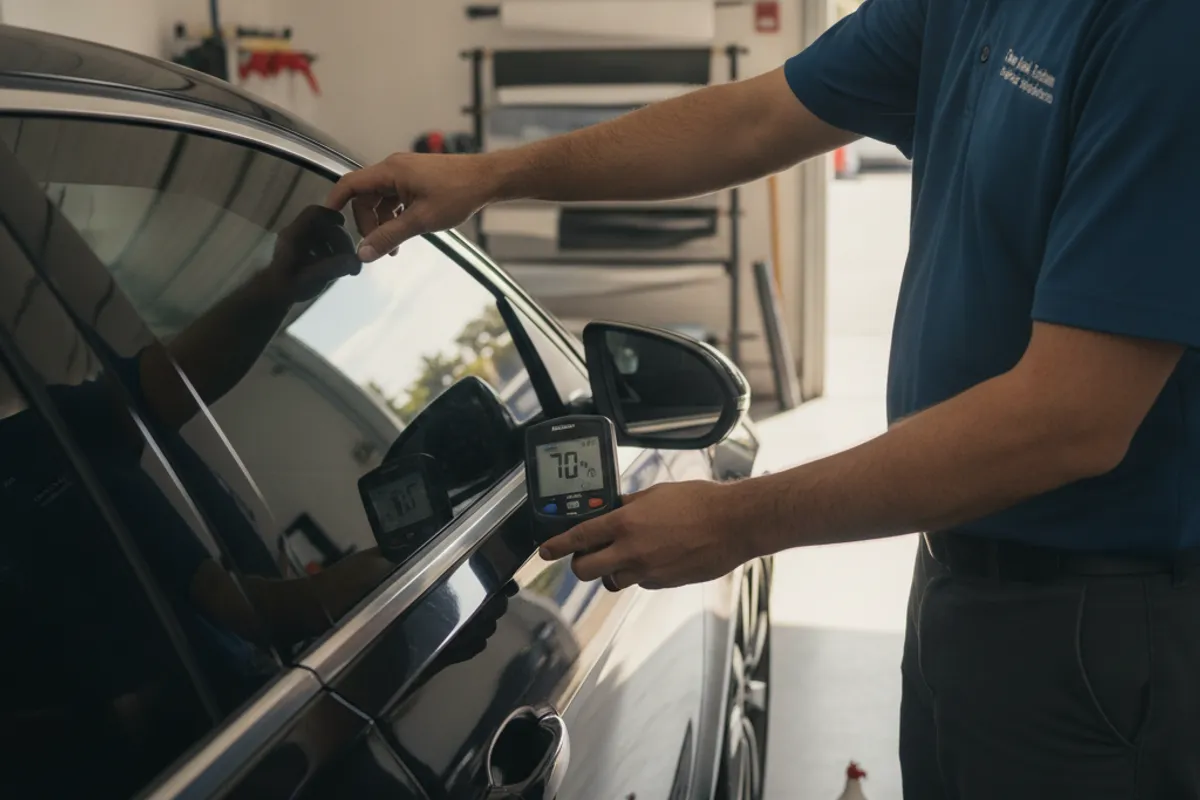
San Diego CHP and city police enforce window tint law through fix-it tickets (VC 26708 violations). A fix-it ticket requires proof of correction and a $25 administrative fee after the violation is corrected and verified. In some cases, officers use a VLT meter to measure compliance at the vehicle.
The front side windows are the most common enforcement point. Rear and cargo windows at any darkness are generally left alone as long as the vehicle has proper mirrors.
What to tell your installer
Before any automotive tint job in San Diego, confirm with your installer:
- The factory glass VLT for your specific vehicle on the windows being tinted
- The combined VLT (glass + film) for each window position, not just the film’s rated VLT
- Whether the front side window film keeps you above 70% combined VLT
A reputable installer should provide this information upfront. If they can’t tell you the combined VLT for front side windows, that’s a red flag.
For more on automotive window tinting options in San Diego and how ceramic film performs compared to standard auto tint, see the automotive window tint service page.
Common questions
Can I get 35% tint on my front windows in California? No. The 70% combined VLT requirement makes any visible-darkness film on front side windows likely illegal unless your factory glass is unusually light. A 35% film on standard factory glass typically results in a combined VLT around 25-28%, which fails California law.
Is 70% tint on rear windows legal? Yes. Any darkness is allowed on rear side and rear windows on vehicles with proper mirrors. A 70% film, 50%, 35%, 20%, or even 5% “limo” tint is legal on rear and rear-side windows in California.
Can my tint have a color? California does not restrict tint color. Red and amber tints are prohibited by other vehicle code sections because they can be confused with safety signals, but all other colors of tint are permitted within the applicable VLT limits.
The bottom line
California auto tint law is specific: front side windows must stay above 70% combined VLT, rear side and rear windows can be any shade with proper mirrors, and nothing reflective is allowed anywhere. Know the rules before installation, choose an installer who measures combined VLT, and you’ll stay legal.
Call (858) 925-5546 to get connected with an insured automotive window tinting installer in San Diego County who knows California law and can confirm your vehicle’s glass spec before the film goes on.