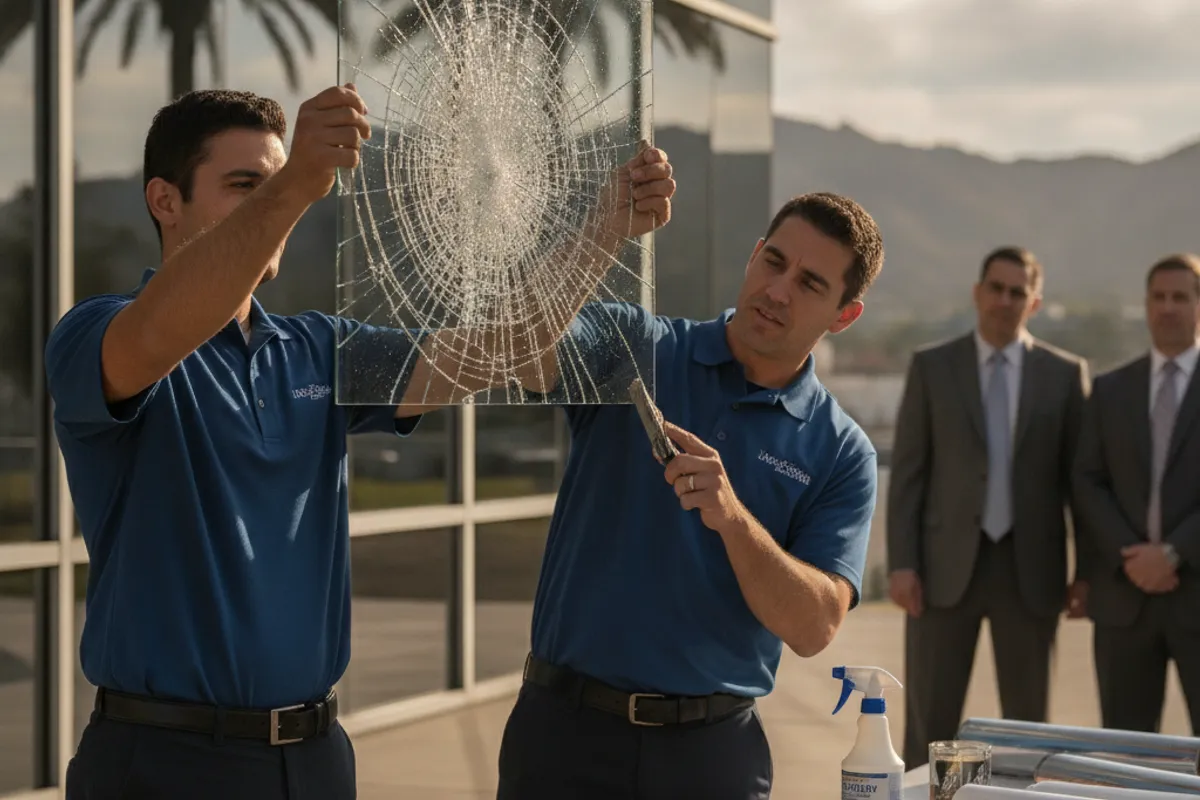
What security window film actually does
Security window film doesn’t make glass bulletproof or unbreakable. What it does is change how glass behaves when it breaks. Without film, a broken window shatters into sharp fragments that fly inward or fall in a cascade. With security film, those fragments stay bonded to the film layer, held in a web of polyester rather than spraying into a room or falling onto a floor.
That single behavior change matters in two different ways depending on your goal.
For safety (accidental breakage): If a ball, a tree branch, or a hailstone breaks a window in your Encinitas or Scripps Ranch home, security film keeps the glass fragments contained. For homes with children, this is meaningful. The same logic applies to glass doors in commercial spaces where accidental impact is possible.
For security (forced entry): Breaking a window is the fastest path into a building that isn’t made of reinforced concrete. A standard residential window takes about 5-10 seconds to break and clear enough to climb through. Security film significantly slows that process. The glass breaks but the film holds the debris in the frame, and creating a large enough hole to enter through requires sustained effort with a tool, not a single strike. Those extra seconds matter.
Security film doesn’t prevent determined forced entry indefinitely. It’s not a vault. What it does is change the calculus for opportunistic break-ins, which make up the majority of residential and commercial burglaries in San Diego County.
How security film differs from standard window tint
Standard window tint film is 1.5-4 mils (thousandths of an inch) thick. It’s optimized for optical clarity, heat rejection, and UV blocking. It’s not designed to hold glass under impact.
Security film starts at 4 mils and runs up to 14 mils for the heaviest duty applications. It uses tear-resistant polyester layers and a stronger adhesive system designed to keep the film bonded to the glass frame even under impact stress. Many security films are clear or lightly tinted, not dark, because the primary goal is protection rather than heat rejection or privacy.
“Safety film” and “security film” refer to the same product category with different applications in mind. Safety film, emphasizing accidental-breakage containment, is often clear. Security film, emphasizing intrusion resistance, is sometimes combined with tint for additional heat rejection and privacy.
Thickness and what it means
- 4 mil: Entry-level safety film. Holds glass on accidental breakage. Provides limited resistance to forced entry. Good for interior glass partitions, glass in homes with children, and areas where accidental impact is the main concern.
- 8 mil: Mid-range security film. Meaningful improvement in forced-entry resistance. The standard recommendation for most residential security applications and small commercial properties.
- 12-14 mil: Heavy-duty security film. Used for high-risk commercial properties, government buildings, and any application where the threat level is more serious than an opportunistic break-in. Requires professional installation because the thickness creates more installation complexity.
Where security film makes sense in San Diego
Ground-floor residential windows in areas with higher break-in rates. Parts of San Diego’s inland communities, including areas of El Cajon, National City, and some neighborhoods in the central city, see more residential burglary than the county average. An 8 mil security film on ground-floor windows and sliding glass doors adds a meaningful layer of protection without making the home look like a fortress.
Sliding glass doors. Sliding glass doors are a common entry point in residential burglaries because they’re large, often in less-visible backyards, and the glass is typically not as thick as window glass. Security film on sliding glass doors is one of the most cost-effective security investments for San Diego homes with rear yard access.
Commercial storefronts in San Diego. Smash-and-grab burglaries hit retail storefronts by breaking the display window quickly. Security film on storefront glass slows that scenario substantially. It doesn’t make the glass invulnerable, but it changes the time-to-entry enough that many smash-and-grab attempts are abandoned when the window doesn’t clear on the first strike.
Coastal homes in areas prone to windblown debris. Del Mar, Cardiff-by-the-Sea, and areas near Mission Bay sometimes see wind events that can send debris through windows. Safety film reduces the injury risk from those events.
What security film doesn’t do
Security film is not rated to stop bullets, blast pressure from explosions, or sustained attack with heavy tools. It’s not a substitute for reinforced glazing or physical security barriers in high-threat environments. For residential and standard commercial use, it’s a meaningful deterrent and injury-reduction tool.
It also doesn’t eliminate the need for other security measures. Locks, alarm systems, exterior lighting, and visible cameras all contribute to deterrence. Security film works best as one layer in a broader security approach.
For more on security film options and how they combine with other window treatments, see the security and safety film service page.
What an installation looks like
Security film is applied like standard window film from inside the glass surface. The main visible difference is the thickness during installation and the need for proper edge anchoring on the film. Good installers use an edge attachment system that anchors the film to the frame, which keeps the film bonded to the structure rather than just to the glass. Frame anchoring substantially improves security film performance on forced-entry scenarios.
The bottom line
Security window film holds broken glass in place, slows forced entry, and reduces injury risk from accidental breakage. It’s not a guarantee against intrusion, but it changes the dynamics enough to matter for most residential and commercial security situations.
If you want to know whether your San Diego home or business is a good candidate for security film and which thickness makes sense, call (858) 925-5546. We’ll connect you with an insured local installer who can assess your specific windows and give you honest guidance.