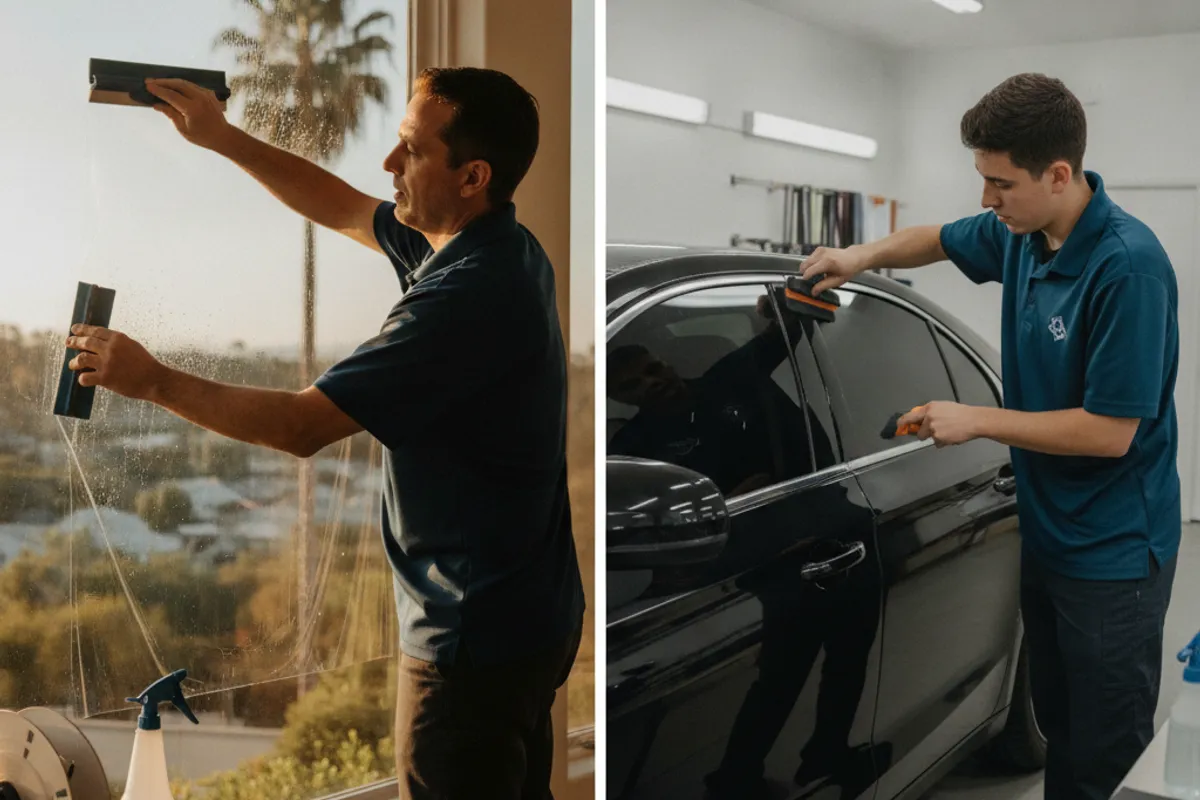
They share a name but they’re different products
Both residential and automotive window tinting involve applying a thin polyester film to glass. That’s where the similarity mostly ends. The films, the installation process, the longevity expectations, the regulatory environment, and the performance goals are different in ways that matter if you’re planning to tint either your home or your car.
The film itself
Residential window film is thicker and is engineered for flat, stationary glass. It handles larger surface areas, uses different adhesive systems designed for long-term adhesion on tempered or laminated flat glass, and often includes multiple performance layers for heat rejection, UV blocking, or security. Residential film products are generally warranted for 10-20 years on the film itself.
Automotive window film is engineered for curved glass surfaces, the thermal cycling of a car parked in the sun for hours, and the defroster grid on rear windows. Automotive films must bond properly to curved glass without wrinkling and must not interfere with the conductors embedded in rear glass defrosters. Automotive film products typically carry 5-10 year warranties.
Using automotive film on home windows or residential film on car windows is not recommended. The adhesive systems and installation tools are different, and a film applied to the wrong substrate type tends to fail early.
Installation differences
Residential installation happens on large flat glass panels, often from inside the home. The installer uses large squeegees, slip solution, and trimming tools designed for flat glass. Most residential installations take 2-4 hours for a full home.
Automotive installation requires film to conform to curved glass, which demands heat guns, dedicated squeegees for curved surfaces, and careful technique around defroster elements. A quality full-car tint job takes 1-3 hours depending on vehicle type. Cheaper installers skip pre-cut patterns and cut around templates directly on the glass, which risks scratching interior surfaces.
VLT and legal rules
For residential window film, California has no VLT minimum for home windows. You can install any darkness of film on any home window you want. The only state restrictions that touch residential tint relate to HOA rules (a private contract issue, not a state law) and some local codes for commercial storefronts.
For automotive film, California Vehicle Code 26708 sets specific VLT minimums by window position. Front side windows must maintain more than 70% combined VLT (glass plus film). Rear side and rear windows can be any shade as long as the vehicle has both outside mirrors. The windshield can only have a non-reflective top strip.
This is one of the most important practical differences. You can tint your living room windows to 5% VLT if you want privacy and maximum heat rejection. Tinting your front car windows to 35% VLT in California will get you a fix-it ticket.
Longevity
Quality residential ceramic film installed on a home window can last 15-20 years before needing replacement. The glass stays stationary, doesn’t flex, doesn’t cycle through the extreme temperature swings of a car parked in the sun and then driven through cool evening air, and the film isn’t touched the way car windows are.
Automotive film faces harder conditions. Cars flex slightly at speed, temperature cycling is more extreme (a black car interior in the Santee summer sun can reach 160-170°F inside with the windows up), and the film on door glass is compressed and released every time the window goes up and down. Quality automotive film lasts 5-10 years under these conditions. Cheaper film may start bubbling or peeling in 3-5 years in San Diego’s UV environment.
Performance goals
Residential window film is primarily optimized for heat rejection, UV blocking, and privacy, with glare control as a secondary benefit. A homeowner tinting a west-facing living room in Kearny Mesa is mainly trying to reduce the heat load and furniture fade.
Automotive film is primarily optimized for heat rejection, privacy, and legal compliance with California’s VLT rules. The UV protection is also real, a quality automotive film blocks 99% of UV radiation, which protects your skin during commuting and reduces interior fading on the dash, seats, and trim.
For the residential side, see the residential window tint service page. For automotive, see the automotive window tint page.
Can one installer do both?
Many window tinting shops in San Diego do both residential and automotive work, but they’re separate skill sets. A shop that primarily does car tint isn’t necessarily set up to handle a whole-home residential job with large flat glass panels. Ask specifically what the installer’s experience is for the type of work you need.
The bottom line
Residential and automotive window tint use different film products, require different installation techniques, follow different legal rules, and have different longevity expectations. Don’t apply them interchangeably and don’t assume the cheapest shop can do both well.
If you’re tinting a home, a car, or both, call (858) 925-5546. We’ll connect you with insured, experienced window tinting installers serving San Diego County who specialize in the right category for your job.